THE MEDICARE PAYMENT CONVERSATOIN PHYSICIANS ARE HAVING: And Why the Public Should Hear It Too
There are some conversations happening inside medicine that the public rarely gets to hear in full. This is one of them.


Earlier this month, an article by MedPage Today reported that “Physicians would receive a 1.68% pay cut -- or a 1.19% pay cut for those participating in advanced alternative payment models -- in 2027 under the proposed CMS Medicare Physician Fee Schedule.”
But this didn’t come as a surprise to me, as myself and many others have talked about it in the past. I actually wrote an article last year - Is Enough, Enough Yet (2025)? .
Where my perspective splits
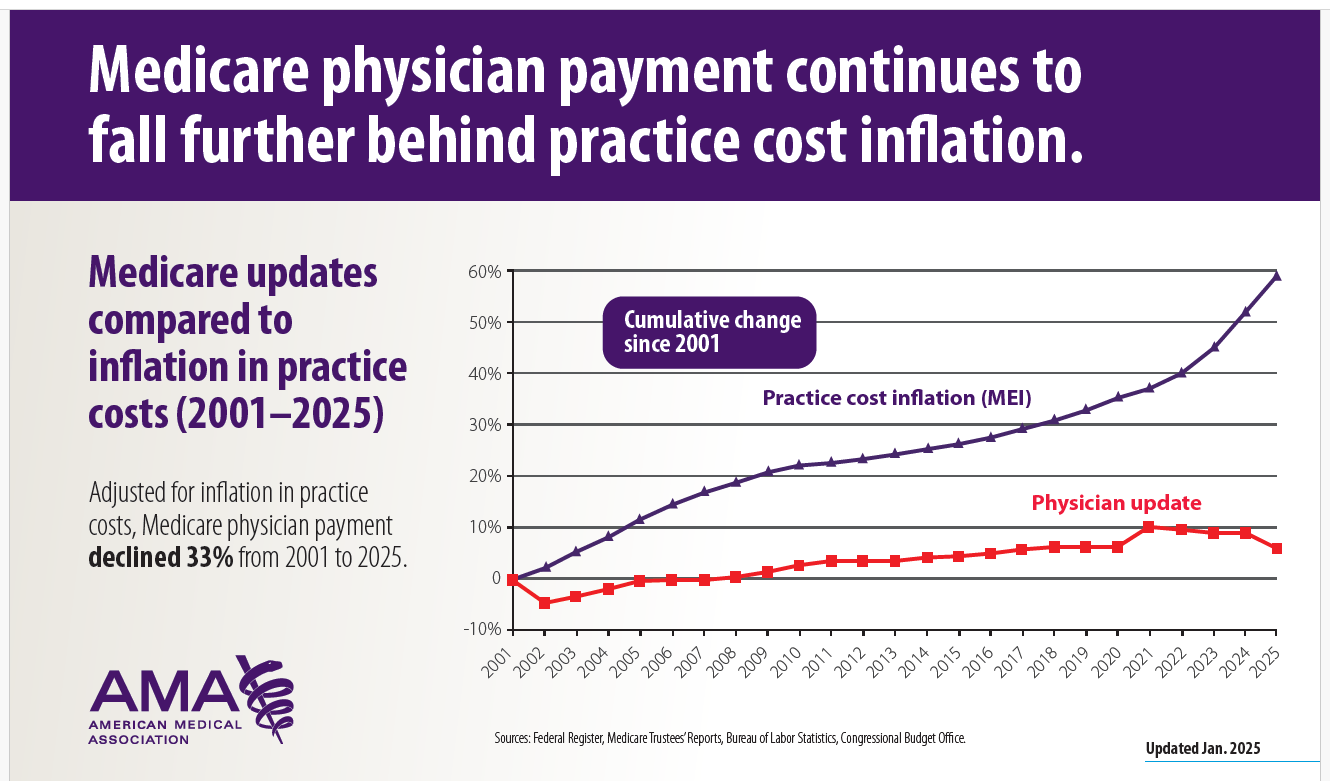
I understand exactly why physician groups are speaking up right now. They’re right to say that Medicare physician payment hasn’t kept pace with what it actually costs to run a practice, and that once you adjust for inflation, those payments have dropped sharply since the early 2000s.
They’re also right to call out how “budget neutrality” can turn one specialty’s gain into another doctor’s loss, because when payment goes up in one area, something usually has to come down somewhere else.
I believe in innovation, and clinically, it is truly amazing what each year brings as far as progress in diagnostics, treatments, and procedures. No one would disagree that this is a good thing; we all want advances that help physicians take better care of their patients. But my world has felt split for a long time once the conversation shifts from clinical excellence to the business reality of private practice and reimbursement tied to health insurance plans, including those connected to the federal government. That’s where the tension shows up for me.
And even though my own practice is opted out of Medicare, I still pay close attention to these changes. The rules and payment decisions may not run through my billing system anymore, but they absolutely affect my patients, my colleagues, and the landscape my specialty has to live in.
How it shows up in my exam room
In my own practice, most of the people I see aren’t thinking about policy—they’re thinking about whether they can keep walking without pain and stay out of the hospital. Well over 80% of my patients have some form of insurance, and more than 40% are covered by Medicare, so when reimbursement comes up, it’s never just a theoretical argument for me. I see it play out in the lives of my patients who are trying to stay mobile and independent. Medicare sits right in the middle of that picture and is a major payer for podiatric care in seniors when the care gets labeled “medically necessary,” especially for those living with diabetes. When podiatrists are part of the diabetes care team, studies show that the risk of lower‑limb amputation can drop dramatically (up to 85%) and hospitalizations for foot complications fall (as much as 24%) as well; that’s the kind of impact that changes not just statistics, but how long people keep walking on their own.
At the same time, much of what looks like “routine” foot care on paper is exactly what prevents ulcers, infections, and surgeries in real life—yet it’s often excluded unless very specific criteria are met. Medicare may cover therapeutic shoes or regular foot exams for one diagnosis but deny them for another, even when the deformity, pain, or risk to the patient is essentially the same. In my book Private Practice Solution, I called this a different kind of “diagnosis discrimination,” because the real driver isn’t the patient’s condition; it’s the code attached to that condition. The system doesn’t ask, “Is this foot at risk?” It asks, “Does this code unlock coverage?”
That’s why I keep coming back to this issue. Seniors use podiatric services, and the data are clear: where podiatrists are involved in diabetic care, amputation rates and hospitalizations go down. Yet the care that helps keep people walking, working, and living independently is often the same care squeezed hardest by rigid coverage rules. When a code decides whether that care “counts,” patients understandably wonder why what we both see in the exam room doesn’t always translate into what their benefits recognize.
What associations are asking for
Physician organizations are not wrong to say the current system is broken. They’re asking Congress for more stability, better updates, and reforms that would keep every payment change from turning into a zero‑sum game. As someone who actually runs a practice, I understand why. When you’re responsible for payroll, rent, staff, technology, supplies, and compliance - and you still want to deliver excellent care - you can’t just ignore a payment system that keeps eroding the foundation under your feet.
So yes, I understand the lobbying. I understand the legislative push. And I understand why physicians are being encouraged to support bills that promise to “protect physician payment” and “protect patient access.” Those concerns are real.
The bigger issue
Unfortunately, that’s not the whole story.
The deeper problem isn’t only that physicians are underpaid. It’s that too much of modern medical practice is built inside a structure where prices are set far away from the exam room, adjusted through formulas, and constrained by political rules that don’t reflect the actual day‑to‑day work of taking care of people. Even if payments went up tomorrow, that structure would still be sitting there.
That’s why annual payment patches never feel like a real fix. They may ease the pressure for a while, but they don’t change the architecture. They don’t restore flexibility. They don’t reduce the administrative weight. And they don’t give physicians or patients more control over the relationship that should matter most.
This is also a big reason consolidation keeps happening. Lower payment is one piece of the puzzle, but complexity is another. Large systems can absorb administrative burden, regulatory demands, and overhead in ways smaller, physician‑owned practices often can’t. So when independent physicians retire, merge, sell, or limit participation, it’s not shocking—it’s what happens when the rules increasingly favor size over service.
Why this matters to patients
The public needs to understand what’s at stake. When an independent practice closes or pulls back, it isn’t just a physician problem. It changes accessibility, availability, and affordability in the community. Patients may wait longer, travel farther, lose continuity, and have fewer real choices about where and how they receive care.
Patients are part of this story too. When you choose to see doctors who are transparent about pricing, who protect the time they spend with you, and who build care around the doctor-patient relationship and not a spreadsheet, you’re helping reshape how care is delivered. Your questions, your choices, and your support for practices that put that relationship first all matter.
And this conversation isn’t over. Some physicians are quietly choosing a different path and structuring care in ways that sit outside the most rigid parts of the system. That deserves its own discussion—and it’s one I plan to have. Stay tuned!
Do you recall when MACRA rolled out? The “rules” as stated made it clear, we were not collectively going to see increased reimbursement.
Further, 25% of physicians who met “quality” metrics were to see a raise; at the expense of the bottom 25% who failed quality rules. Whatever happened to that formula?
We can lobby all we want, due to demand exceeding supply and a fixed budget, we get the shaft every time.
This is why I submit, the only logical conclusion professionally is to pivot, stop begging and leave the program.
Dr. Torres-Hodges, the asks you describe are reasonable, and they run on a different clock than the losses. Congress can revisit a formula next year. Once a practice is sold, it isn’t sitting there waiting for the update. A fix can still arrive after the thing it was meant to protect is gone. That timing belongs in the protection argument too.